

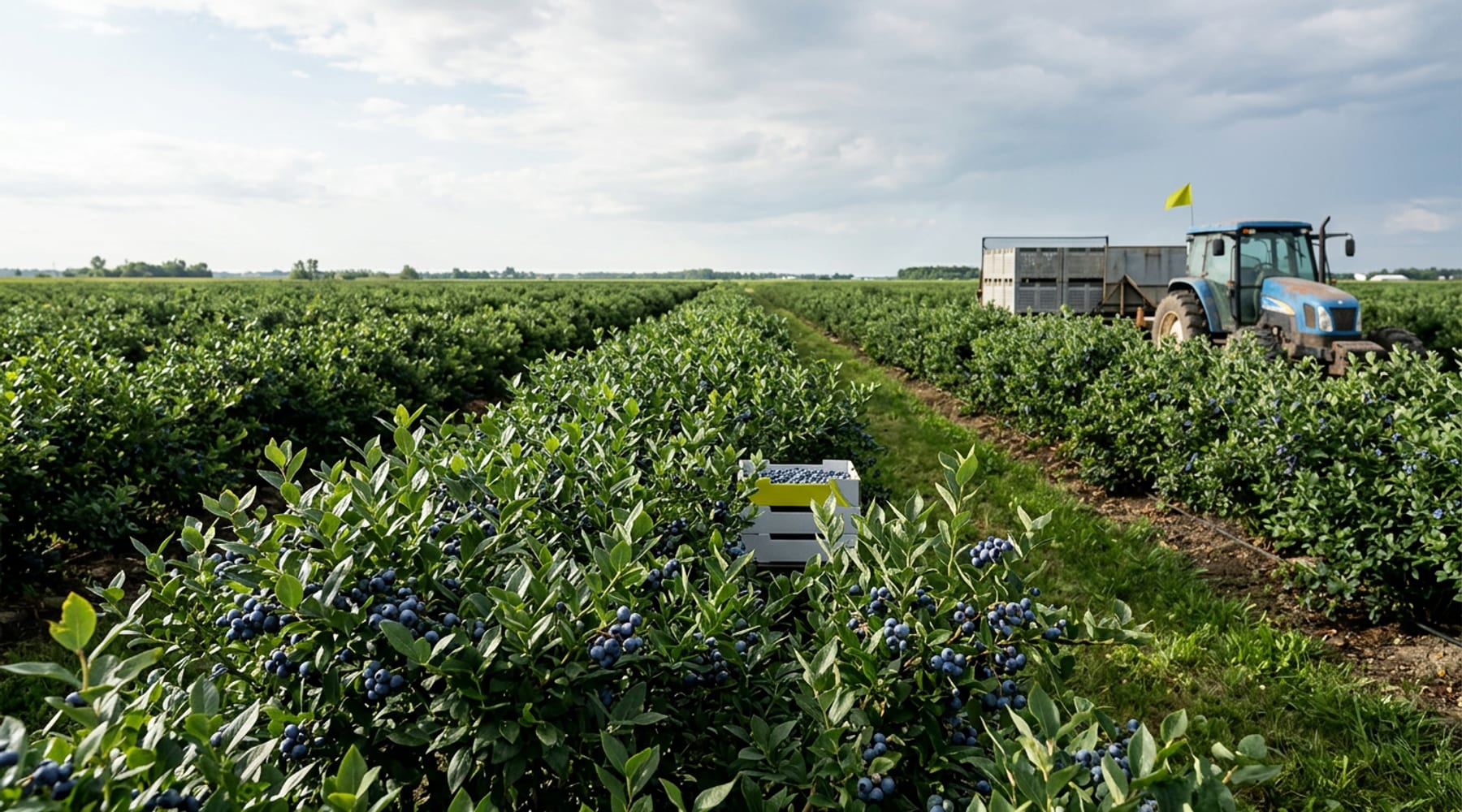
Navigating the 2026 Blueberry Market: Supply Volatility and Procurement Strategy
We hope you are doing well and enjoying the first weeks of summer with your loved ones. As B2B food professionals map out their production schedules, understanding the agricultural realities driving raw material availability is critical for mitigating operational risk. Once again, this year, we have gathered the most relevant information available to help provide an accurate picture of the current state of the blueberry industry. Whether your R&D teams are formulating new offerings in bakery, developing functional lines for pharma and nutraceutical applications, or scaling up private label products, securing consistent, high-quality ingredients remains the foundation of your brand reputation.
Let us begin with the cultivated blueberry market in North America. The 2026 season has already been marked by a series of weather-related challenges across the East Coast of the United States, ranging from significant frost events in Florida to additional weather issues as far north as New Jersey. This difficult start created additional opportunities for other growing regions to supply an exceptionally strong fresh market, a role that the Pacific Northwest is now beginning to fulfill. However, the latest forecasts have also revised production expectations for Washington State, Oregon, and British Columbia.
Weather Volatility Across Key Cultivated Regions
Additional weather concerns have also emerged in other key cultivated blueberry producing regions. Michigan experienced a period of intense heat as recently as last week, while New Jersey continues to face weather-related challenges. Together with earlier weather events affecting North Carolina and other growing areas, these conditions are further reducing production expectations. As a result, industry estimates now suggest that total cultivated blueberry production in North America could finish approximately 100 million pounds below last year's crop.
For industrial manufacturers and procurement leads, this deficit requires a proactive pivot in supply chain strategy. When fresh and frozen availability tightens, relying on spot-market purchases introduces severe vulnerabilities into your manufacturing schedule. Diversifying your ingredient formats by incorporating reliable alternatives such as microdried blueberry pieces, iqf fruits and vegetables, or concentrated blueberry juice can help stabilize your production lines without compromising the sensory profile of your end products.
The Wild Blueberry Industry: Yields and Carryover Pressures
This brings us to the Wild Blueberry industry. The intense heat wave that recently impacted Maine, Quebec, and parts of the Maritime provinces has raised concerns about yield potential, particularly in fields that had already experienced weaker plant development earlier in the season.
In addition, frost events during bloom in Maine, Nova Scotia, and Prince Edward Island significantly reduced crop potential and continue to support expectations of an average crop at best. At present, an average crop would likely translate into approximately 280 million pounds of production. However, one critical factor deserves special attention: the near-complete absence of carryover inventory.
Unlike last season, when existing inventories provided a limited buffer against weather-related production challenges, the industry enters the new pack year with virtually no surplus inventory available to bridge supply until the first harvest shipments become available. As a result, a portion of the 2026 crop is effectively already committed to fulfilling the remaining contractual obligations from the 2025 pack. In practical terms, we estimate that at least 10% of the upcoming crop has already been allocated before harvest begins.
Industrial Versus Retail Allocation Dynamics
Procurement professionals managing supply chains for industrial manufacturing must also account for distinct market segmentations. It is important to note that Organic Wild Blueberries should largely be considered separately when assessing industrial supply availability for Europe, North America, and Asia, as most of the organic production continues to be directed toward the retail sector.
This means that industrial buyers seeking certified organic dried wild blueberries or organic blueberry puree must establish forward contracts early. Waiting until the peak of the processing season risks encountering severe allocation limits, particularly given the compressed inventory buffers currently observed across the supply chain.
Strategic Ingredient Formulation in a Tight Market
When raw fruit availability contracts, product developers face the challenge of maintaining flavor consistency, color integrity, and nutritional labeling targets across complex formulations. Whether you are creating fruit preparations for dairy products, developing fillings for bakery items, or incorporating fruit inclusions into prepared meals and baby foods, formulation flexibility is your greatest asset.
At PROingredients, our in-house culinary innovation team works directly with R&D professionals to adapt formulations to market realities. Utilizing alternative formats such as specialized purees, concentrated blueberry juice, or shelf-stable dried blueberries ensures that your product lines maintain their signature taste and visual appeal even when whole-fruit yields fluctuate.
Key Considerations for R&D and Procurement Teams
- Early Commitment: With approximately 10% of the upcoming crop already allocated to previous commitments, securing your volume requirements ahead of peak harvest is essential.
- Format Diversification: Explore multiple formats—including IQF, purees, juices, and dried variations—to insulate your production schedule from single-source vulnerabilities.
- Transparent Partnership: Align with a disciplined ingredient partner who monitors global agricultural shifts in real time and maintains transparent communication regarding crop developments.
Conclusion: Proactive Planning for Long-Term Resilience
We hope this initial market overview proves useful as we collectively monitor crop development over the next several weeks. While current indicators point toward an average crop, we remain cautious, as we are still one full month away from harvest—a period during which extreme heat significantly altered production expectations last year.
Navigating supply volatility requires moving away from reactive purchasing and building deep, collaborative partnerships that prioritize traceability, disciplined sourcing, and regulatory excellence. In the meantime, please do not hesitate to contact us should you have any questions or wish to discuss market conditions in greater detail. Contact our team at PROingredients today to secure your volume allocations and optimize your ingredient strategy for the upcoming season.


